
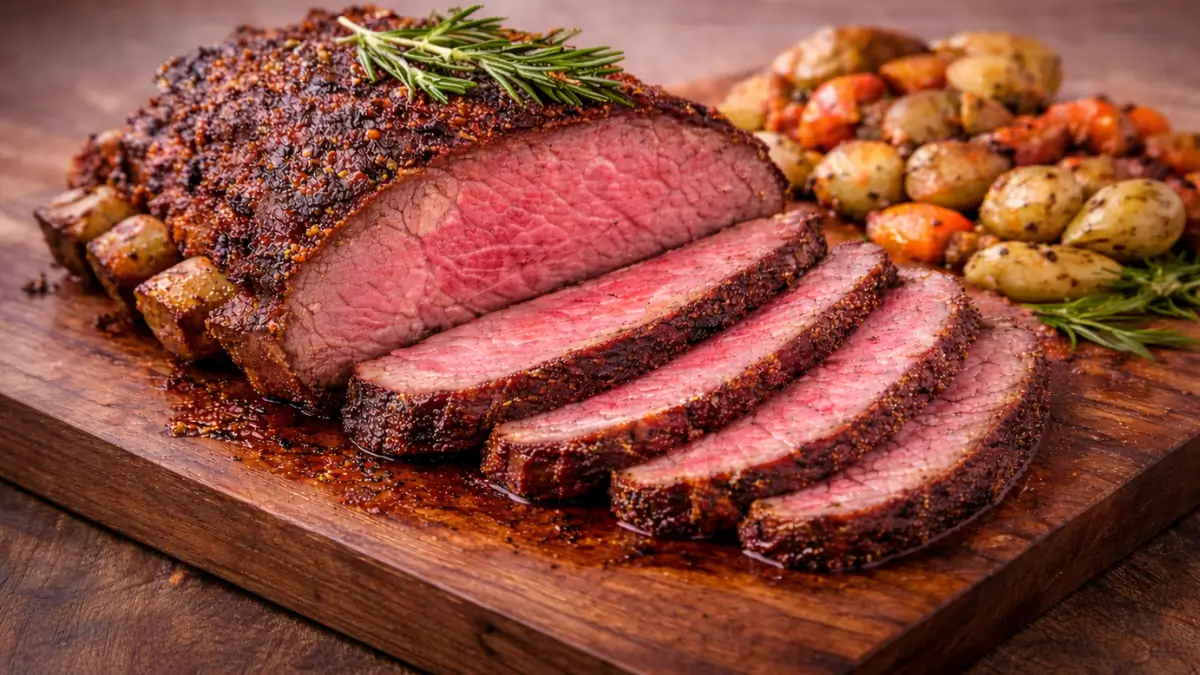
A bone-in ribeye roast is one of the most impressive cuts of beef you can cook at home, and this guide shows you exactly how to do it right. You’ll get a clear oven method, a bone-in ribeye roast cooking time chart, and the exact internal temperatures to help you serve a juicy roast with confidence.
The basic method is simple: season the roast generously, sear it at high heat to build a flavorful crust, then finish it at 325°F until a probe thermometer says it is ready. For medium-rare, pull the roast from the oven at 120 to 125°F and let it rest until it reaches 130 to 135°F.
Cooking ribeye roast on the bone adds extra flavor, slows cooking slightly on the rib side, and creates a beautiful presentation for holidays and special dinners. Whether you are making it for Christmas, Easter, or a weekend meal that deserves something memorable, this bone-in ribeye roast recipe will walk you through every step.
Table of Contents
Why Cook Ribeye Roast on the Bone?
More Flavor from the Bone
The bones in a standing rib roast do more than hold the structure together. As the roast cooks, the bone marrow and surrounding connective tissue slowly break down, releasing gelatin and fat into the meat closest to the rib. The result is a richer, deeper flavor right at the bone the strip of beef nestled against each rib is the most prized bite on the plate.
The science behind whether bone truly transfers flavor into the interior of the meat is debated among chefs, but what is widely agreed upon is the insulation effect: the bones absorb heat and slow down cooking on the rib side. This gives you more even results across the cross-section of each slice, with less risk of the meat near the edges drying out before the center catches up.
Does Bone-In Stay Juicier?
Yes — and here is why. The bones act as a heat buffer on one side of the roast. While the exposed top and sides are cooking from the outside in, the bone side progresses more slowly. This difference in heat transfer means the overall moisture loss is reduced in that zone, and the finished slices have a noticeably juicy strip along the bottom where the bone ran.
There is also the practical benefit of presentation. A bone-in roast stays in better shape during cooking because the bones provide a natural support structure, keeping the eye from spreading flat in the pan.
When Bone-In Is Better Than Boneless
Bone-in wins for any occasion where presentation matters. A standing rib roast resting on its bones at the center of a holiday table is one of the most dramatic things you can serve. It signals effort, quality, and generosity.
Bone-in also wins for larger roasts cooked over a longer time. The slow, forgiving nature of a low oven suits the bone-in cut well the insulation helps prevent the exterior from overcooking while a large center comes up to temperature. For smaller, quick-roasting cuts or weeknight dinners, boneless is a perfectly excellent and much easier choice.
Is a Bone-In Ribeye Roast the Same as Prime Rib?
This is one of the most common questions home cooks have before they even reach the butcher counter and the answer is yes, essentially. But the naming deserves a fuller explanation.
Ribeye Roast vs Prime Rib Explained
Both cuts come from the same section of the cow: the rib primal, specifically ribs 6 through 12. A prime rib is almost always presented bone-in, roasted whole, and sliced at the table. A ribeye roast more commonly refers to a boneless version of the same cut. When the bone-in version stands upright in the roasting pan on its ribs, it earns the name “standing rib roast” which is simply a bone-in rib roast, described by how it cooks.
One important point that confuses many shoppers: the word “prime” in prime rib refers to the cut, not the USDA grade. You can buy a Choice-grade prime rib, and it will still be called prime rib. If you want USDA Prime beef the highest grade, with the richest marbling you will need to confirm the grade label separately when shopping.
Why People Use Both Names
Restaurants, grocery stores, and recipe writers use prime rib, ribeye roast, standing rib roast, and bone-in ribeye interchangeably, often based on nothing more than regional habit or marketing preference. The confusion is entirely understandable. What matters most is the cut itself: ribs 6 through 12, with the ribeye muscle intact, cooked as a whole roast.
What to Ask Your Butcher For
Walk up to the counter and say: “I’d like a bone-in standing rib roast, USDA Choice or Prime, from the first cut if you have it.” The first cut ribs 9 through 12, closer to the loin is leaner, more uniform, and easier to slice. The second cut — ribs 6 through 9, closer to the chuck has more fat and connective tissue, which adds bolder flavor but a slightly more irregular texture.
If you want the best of both worlds, ask the butcher to cut the bones off and tie them back on with butcher’s twine. You get the flavor and insulation benefits of the bone during roasting, and carving becomes much easier when dinner is ready.
How to Choose the Best Bone-In Ribeye Roast
How Much Ribeye Roast Per Person
For a bone-in roast, plan on approximately 1 pound per person. The bones themselves account for 4 to 6 ounces per rib, so the actual edible beef per person is closer to 10 to 12 ounces a generous serving. If you want leftovers (and you will want leftovers), add one or two extra ribs to your order.
How Many Bones Do You Need
One bone feeds approximately two people comfortably. A four-bone roast will serve about eight guests. Two bones is the practical minimum smaller than that, and the roast lacks structural stability and cooks too quickly to develop the deep, slow-roasted flavor that makes this cut worth the effort.
Prime vs Choice
USDA Prime is the highest grade, characterized by abundant marbling roughly 10 percent intramuscular fat woven through the muscle. It is extraordinarily flavorful and tender, but it costs $17 to $25 or more per pound. USDA Choice has less marbling but is still an excellent cut, far more widely available, and significantly more affordable.
For most home cooks using a generous herb and salt rub and cooking low and slow, a Choice-grade roast produces a superb result. Save Prime for special occasions or when budget is not a concern.
What Good Marbling Looks Like
Good marbling is not the thick fat cap on the outside of the roast that is surface fat, and while it bastes the exterior as it renders, it does not directly affect the interior flavor. What you want to see is fine white streaks woven evenly throughout the red muscle tissue, particularly through the center of the eye. The more evenly those streaks are distributed, the juicier and more richly flavored every bite will be.
Avoid roasts where the fat appears in one concentrated streak or only along the outer edge. Look for a cross-section where the white and red are genuinely intermingled.
Ingredients for Bone-In Ribeye Roast
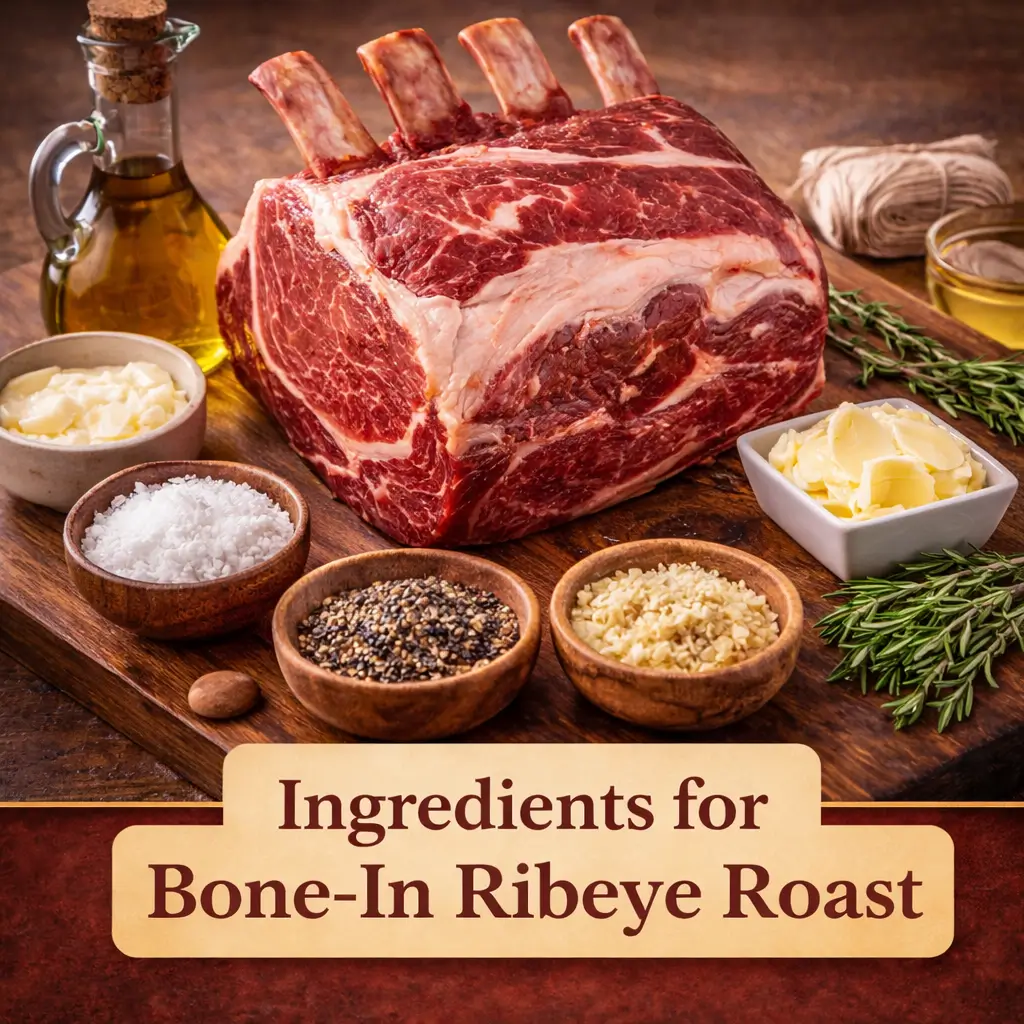
- Bone-in standing rib roast — 2 to 7 ribs, depending on your guest count
- Kosher salt — 1 to 1.5 teaspoons per pound; apply 24 to 48 hours ahead for best results
- Coarse black pepper — freshly cracked, generous coating
- Garlic — 4 to 6 cloves, minced or made into a paste
- Fresh rosemary — 2 to 3 sprigs, finely chopped (optional but recommended)
- Fresh thyme — 3 to 4 sprigs, finely chopped (optional)
- Unsalted butter — 4 tablespoons, softened, for a compound butter rub (optional)
- Olive oil or beef tallow — 2 tablespoons, to bind the dry rub to the surface
The simplest approach and perfectly acceptable is kosher salt, cracked pepper, and nothing else. The quality of the beef is the main event. Everything else is seasoning, not substitution.
Tools You Need
Why a Probe Thermometer Matters
A leave-in probe thermometer is not optional for a roast this expensive and this large. Cooking by time alone is unreliable: your oven may run hot or cold, the shape of the roast affects heat penetration, and the starting temperature of the meat varies. A probe thermometer lets you monitor the center temperature in real time without opening the oven, which drops the temperature inside and extends the cook time unpredictably.
Insert the probe into the thickest part of the eye muscle aim for the geometric center of the roast. Do not let the tip touch any bone; bones conduct heat differently than muscle and will give a falsely high reading.
Roasting Pan and Rack
Use a heavy-duty roasting pan thin pans warp at high heat, cook unevenly, and make it difficult to deglaze for pan sauce. A V-rack or flat rack lifts the roast off the pan floor so air circulates underneath and the drippings fall cleanly into the pan for au jus. If you do not have a rack, a bone-in roast can stand on its bones rib-side down and use them as a natural rack.
Carving Knife and Twine
A long, thin slicing knife 12 to 14 inches is the right tool for carving a large roast. A short blade forces you to saw back and forth, tearing the meat. Butcher’s twine is useful both for tying the bones back on after the butcher cuts them (if you ask for this) and for tying the roast into a uniform cylindrical shape that cooks more evenly.
Bone-In Ribeye Roast Cooking Time Chart
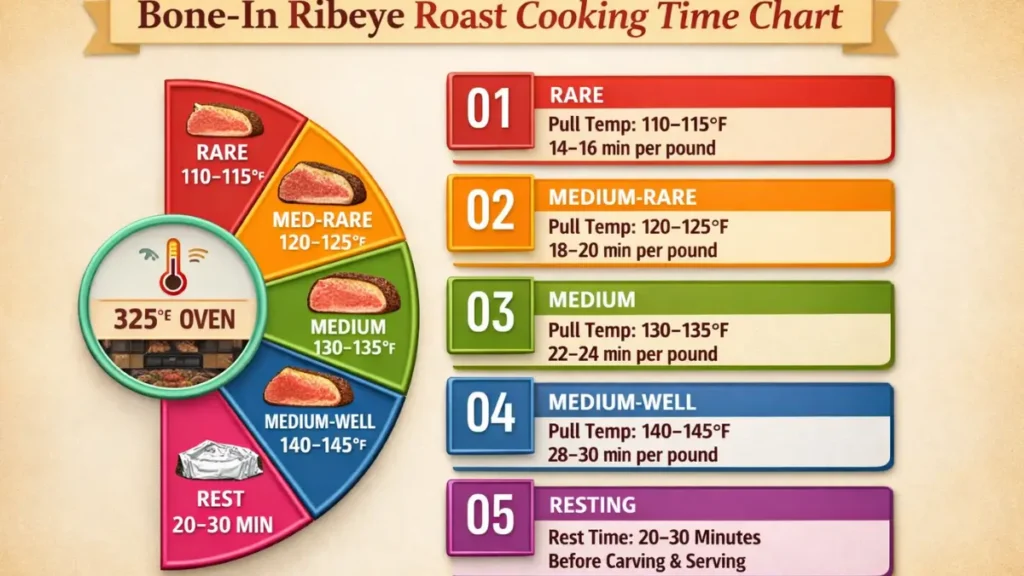
Cooking Time Per Pound at 325°F
The following times assume the roast has been seared at 450°F for 15 minutes first, then the oven temperature was reduced to 325°F for the remainder of the cook. Times are for medium-rare (18 to 20 minutes per pound). Adjust up or down for different doneness levels.
| Doneness | Minutes Per Pound at 325°F | Pull From Oven | Final Temp After Resting |
|---|---|---|---|
| Rare | 13–15 min/lb | 110–115°F | 120–125°F |
| Medium-Rare | 18–20 min/lb | 120–125°F | 130–135°F |
| Medium | 22–25 min/lb | 130–135°F | 140–145°F |
| Medium-Well | 28–30 min/lb | 140–145°F | 150–155°F |
Always use a thermometer. These times are planning estimates. Roast shape, bone placement, starting temperature, and oven variation all affect the result.
Pull Temperature vs Final Temperature
Carryover cooking is the rise in internal temperature that continues after you remove the roast from the oven, driven by the heat stored in the outer layers of the meat. For a roast this large, expect the temperature to rise 8 to 10 degrees during a 20 to 30 minute rest. Always pull the roast 8 to 10 degrees below your target and rest it, tented loosely with foil.
Time Chart in Pounds and Kilograms
The following times are estimates for medium-rare, based on 18 to 20 minutes per pound at 325°F after a 15-minute sear. Add 30 to 45 minutes total to your plan for the sear and resting time.
| Roast Weight | Approximate Cook Time at 325°F |
|---|---|
| 4 lb / 1.8 kg | 1 hr 15 min – 1 hr 20 min |
| 6 lb / 2.7 kg | 1 hr 50 min – 2 hrs |
| 8 lb / 3.6 kg | 2 hrs 25 min – 2 hrs 45 min |
| 10 lb / 4.5 kg | 3 hrs – 3 hrs 20 min |
| 12 lb / 5.4 kg | 3 hrs 35 min – 4 hrs |
| 14 lb / 6.3 kg | 4 hrs 15 min – 4 hrs 40 min |
How to Cook a Bone-In Ribeye Roast in the Oven
Step 1: Bring the Roast Closer to Room Temperature
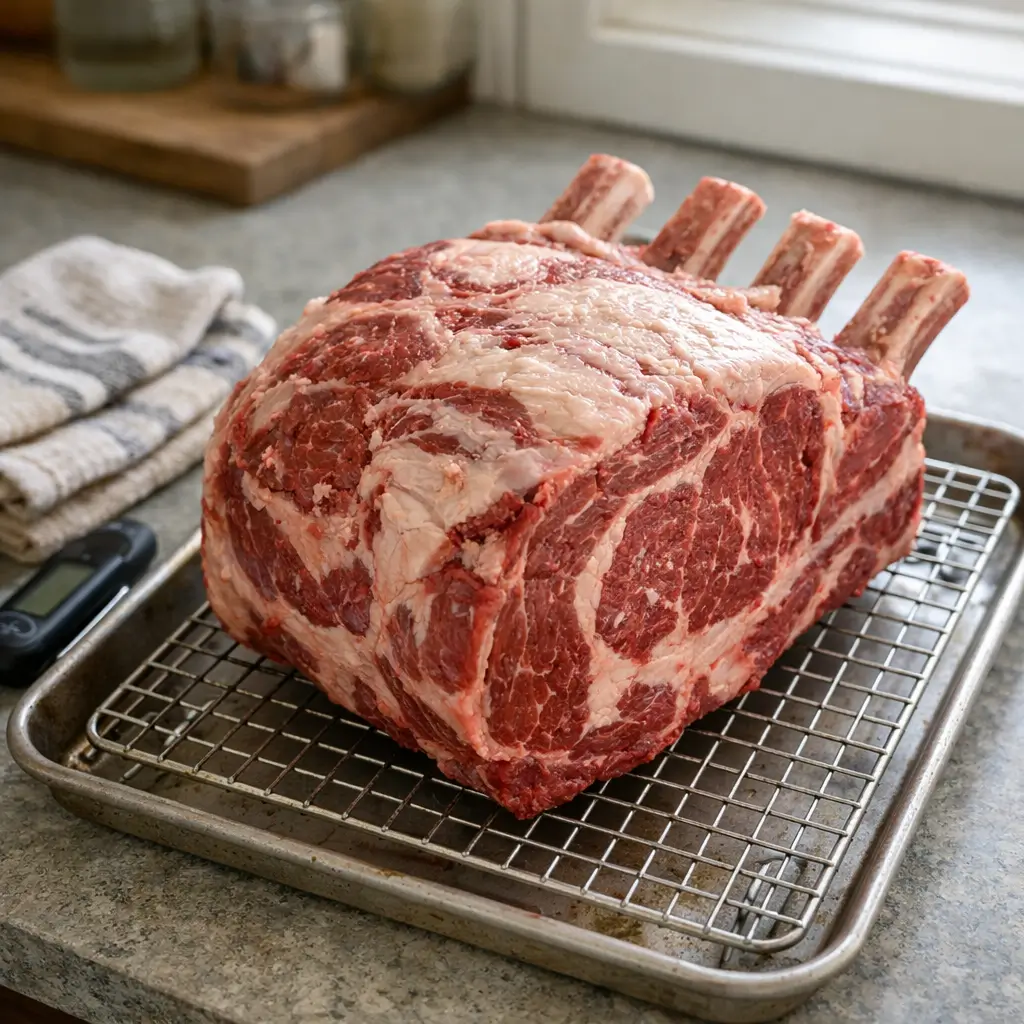
Remove the roast from the refrigerator 1.5 to 2 hours before you plan to cook it. A cold roast is the single most common reason for uneven cooking — the outer layers are done before the center has had a chance to warm up. The USDA recommends not leaving raw meat in the temperature danger zone (40°F to 140°F) for more than 2 hours total, so do not leave it on the counter indefinitely.
Step 2: Season Generously
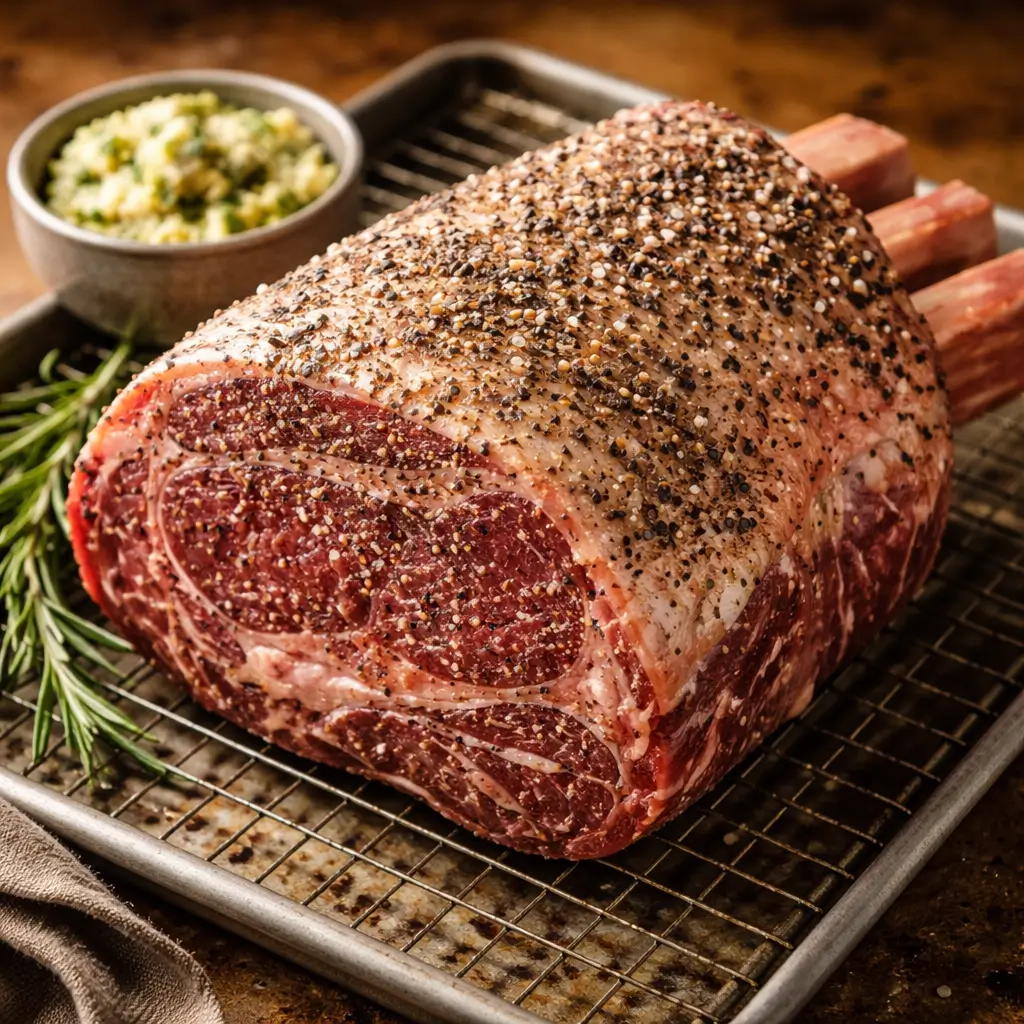
Pat the roast completely dry with paper towels before seasoning. Moisture on the surface creates steam in the oven, which is the enemy of a good crust. Coat all surfaces — top, sides, and the exposed bone ends with kosher salt and freshly cracked pepper. If using a compound butter or herb paste, rub it generously over the entire surface.
For the best crust and deepest flavor, dry brine the roast the night before: salt it generously, place it uncovered on a rack in the refrigerator for 24 to 48 hours. The salt draws out moisture initially, then reabsorbs back into the meat, seasoning it from the inside out and leaving the surface perfectly dry for roasting.
Step 3: Insert the Thermometer Correctly
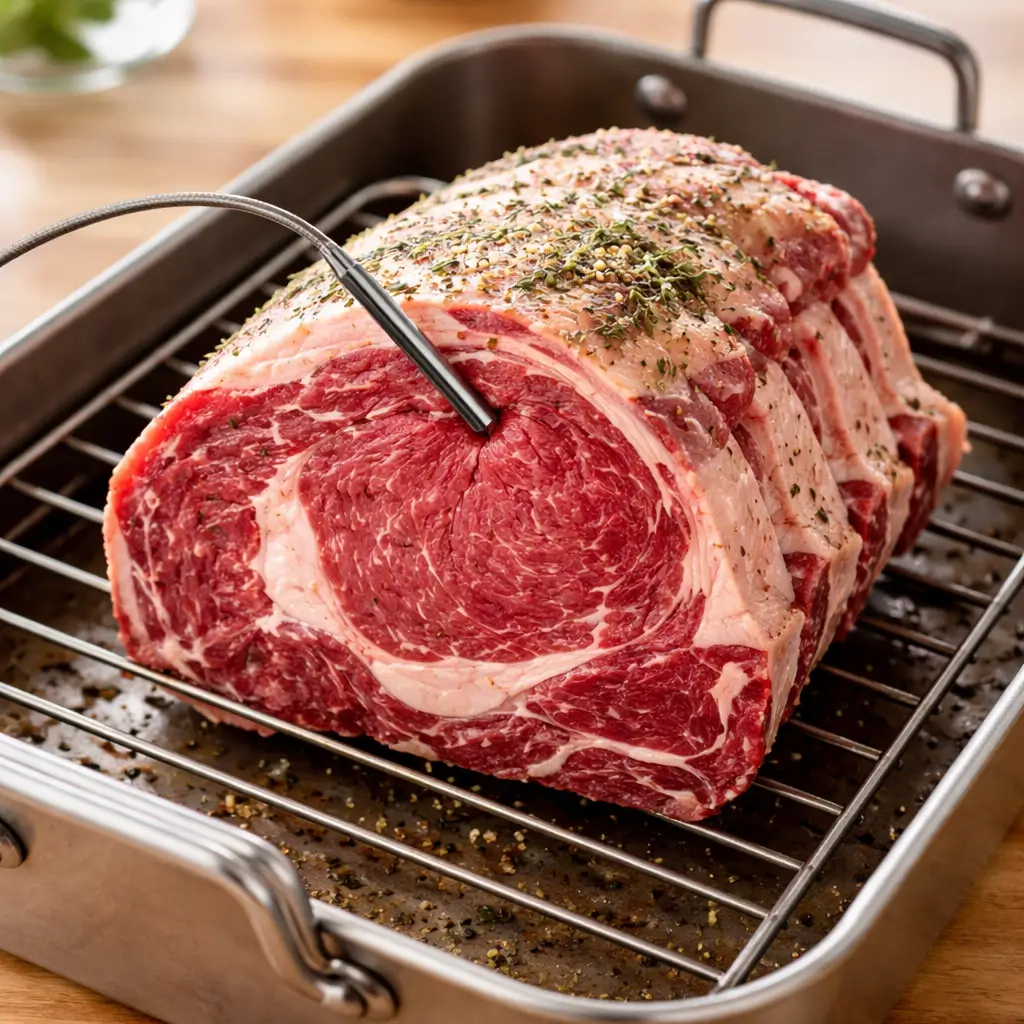
Push the probe into the very center of the thickest part of the eye muscle. This is the geometric center of the roast — the spot that will be the last to reach temperature. If you place the probe near the edge or toward a bone, you will get a false reading and risk pulling the roast too early or too late. Do not let the probe tip touch bone.
Step 4: Start Hot, Then Lower the Heat
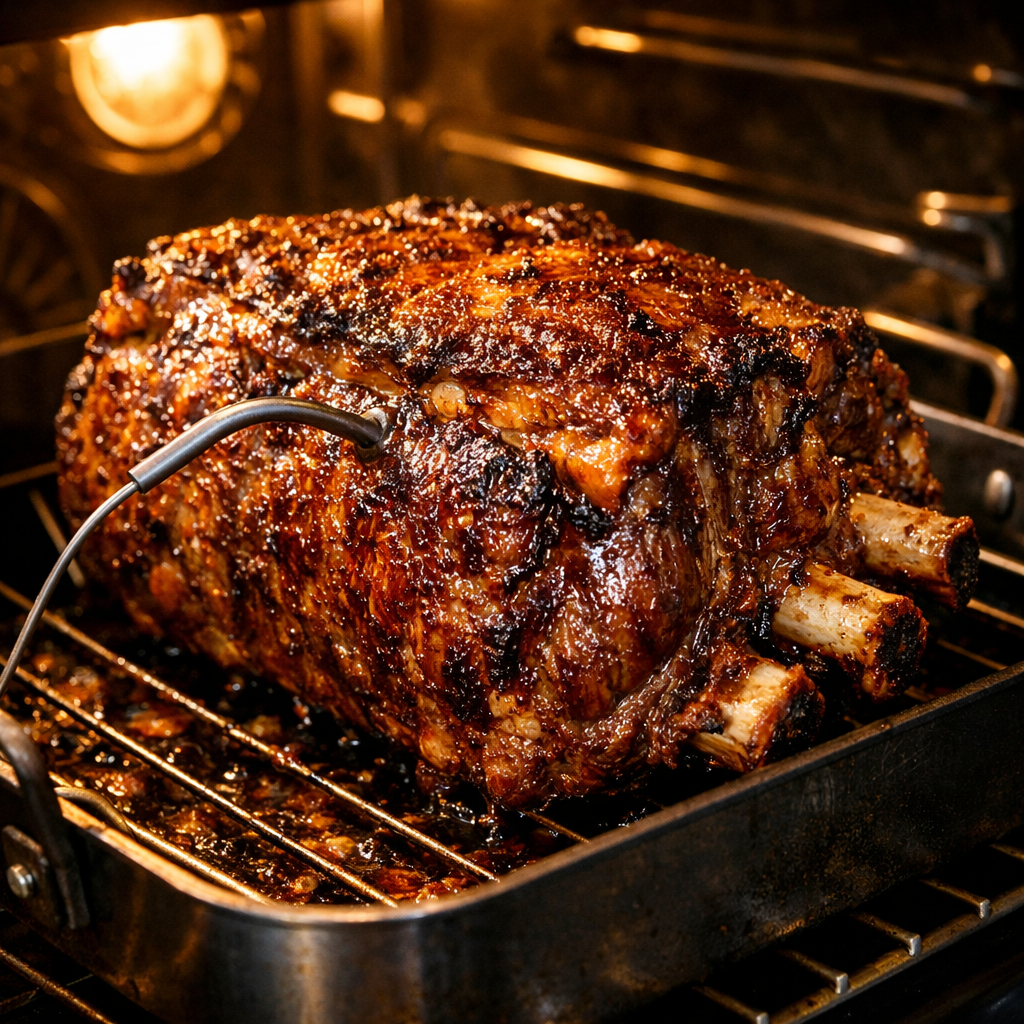
In testing, the most reliable results came from using a leave-in probe thermometer and pulling the roast 8 to 10 degrees before the final target temperature. That approach consistently produced a better crust and more even medium-rare slices than relying on time alone.
Preheat your oven to 450°F (230°C). Place the roast on a rack in the roasting pan, fat-side up, and put it in the oven uncovered. Roast at 450°F for 15 to 20 minutes — this is the crust-building stage. You should see a deep golden-brown to dark brown exterior forming.
After the sear, reduce the oven temperature to 325°F (163°C) without opening the door if possible. Continue roasting until the probe reads 8 to 10 degrees below your target temperature. At that point, remove the roast from the oven immediately — do not wait.
Always cook uncovered. A lid or foil during roasting traps steam and softens the crust you just built. Cover only during resting.
Step 5: Rest Before Slicing
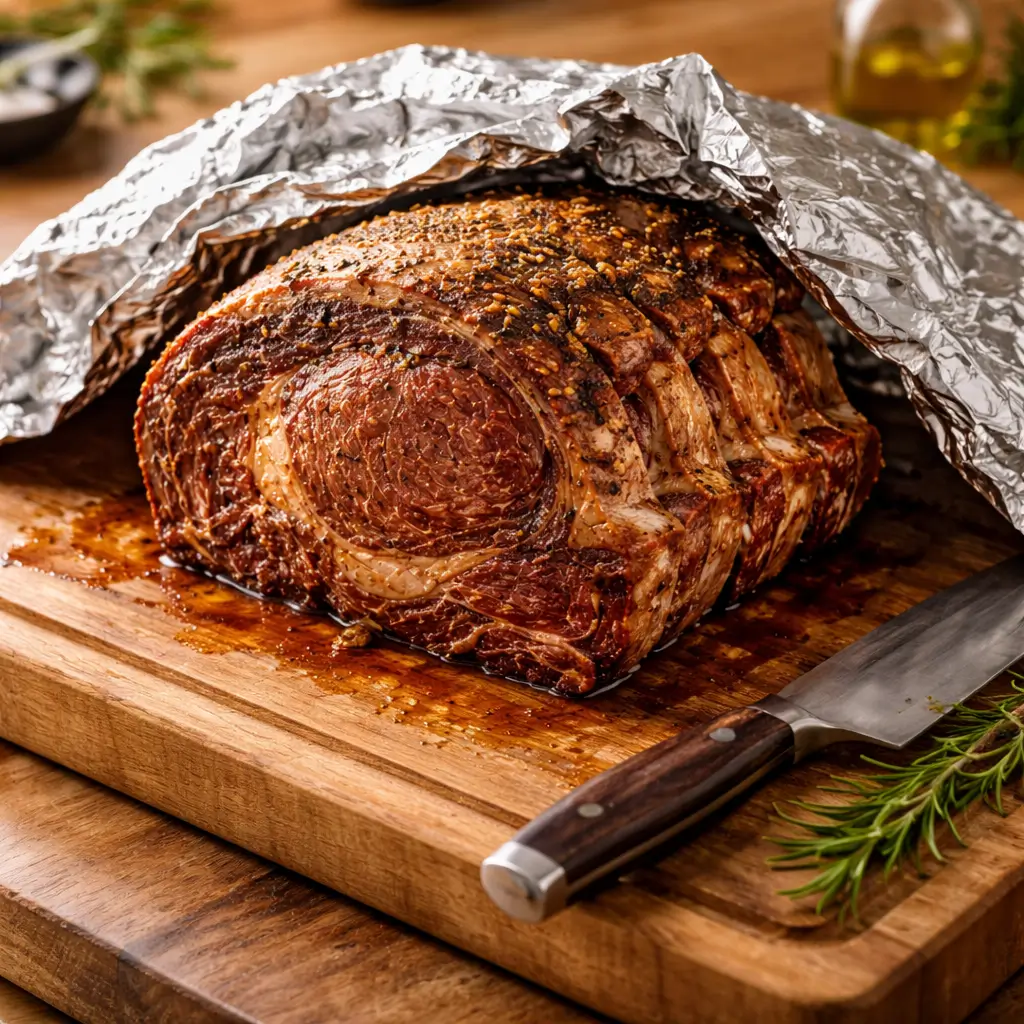
Transfer the roast to a cutting board. Tent loosely with aluminum foil — do not wrap it tightly, or you will steam the crust soft. Rest for 20 to 30 minutes. The internal temperature will continue to rise 8 to 10 degrees during this time.
Resting is not optional. The muscle fibers, tightened by the heat of the oven, need time to relax and reabsorb the juices they pushed out during cooking. Cut too early, and those juices run straight onto the cutting board, leaving the meat dry.
Best Internal Temperatures for Bone-In Ribeye Roast
Rare
Pull from the oven at 110 to 115°F. After a 20-minute rest, the center will reach 120 to 125°F — a cool red center with a deep pink blush toward the edges. This is the doneness preferred by serious beef enthusiasts who want the richest, most tender expression of this cut.
Medium-Rare
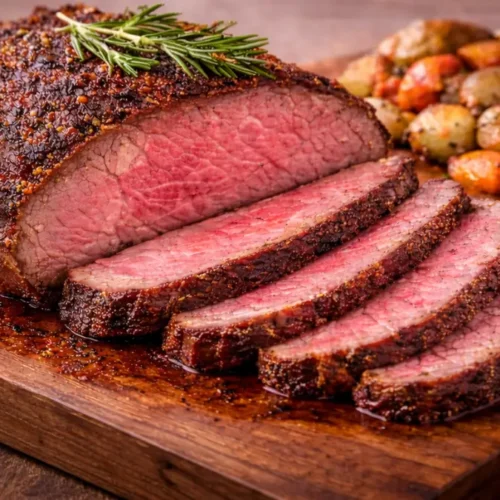
Pull at 120 to 125°F. Final resting temperature: 130 to 135°F. Warm red center, pink throughout, with the fat fully rendered and the texture at its most buttery. This is the doneness most chefs recommend for this cut, and for good reason — it is the ideal balance of flavor, texture, and juiciness.
Medium
Pull at 130 to 135°F. Final resting temperature: 140 to 145°F. Warm pink center, firmer texture. The fat is fully rendered and the meat is still juicy, but some of the silky texture of medium-rare is gone. A good choice for guests who prefer a more fully cooked result without going all the way to well-done.
Medium-Well
Pull at 140 to 145°F. Final resting temperature: 150 to 155°F. Slightly pink center, noticeably firmer. The fat has rendered but the muscle is beginning to dry out. This is the upper limit for this cut — beyond this point, the marbling that makes ribeye exceptional has done its job and the meat begins to toughen.
For an official food safety reference, see the USDA safe beef temperature chart before serving your roast.
Should You Use the 500 Rule for Prime Rib?
What the 500 Rule Means
The 500 rule is a well-known oven method for cooking prime rib without a meat thermometer. The formula is simple: multiply the weight of your roast in pounds by 5 to get the number of minutes to cook at 500°F. After that initial burst, you turn the oven completely off, keep the door sealed, and leave the roast inside for exactly two hours. Residual heat finishes the cooking with no intervention.
For example: a 7-pound roast cooks at 500°F for 35 minutes, then the oven is switched off and the door stays shut for 2 hours.
Why the Sear + 325°F Method Is More Reliable
The 500 rule has one significant weakness: it depends entirely on how well your oven retains heat after it is switched off. Modern ovens — particularly those with cooling fans — can lose significant heat within an hour, leaving the roast undercooked. Readers of multiple popular recipes have reported results ranging from slightly underdone to completely raw, particularly with gas ovens and newer electric models with rapid-cool features.
When you are working with a $100-plus cut of beef for a holiday dinner, the last thing you want is to open the oven after two hours and find cold, congealing beef. The sear + 325°F method with a leave-in probe thermometer eliminates that risk entirely. You always know exactly where you are in the cook, you can adjust if something is going wrong, and you are never locked out of your own oven.
Which Method Is Better for Beginners
For beginner cooks, the sear + 325°F method wins on reliability and confidence. A probe thermometer costs very little, removes all the guesswork, and turns what feels like a high-stakes cook into a manageable, monitorable process.
The 500 rule can work beautifully — many cooks swear by it — but it is best suited to boneless roasts in the 4 to 7 pound range in a well-insulated oven. If you know your oven holds heat extremely well and you prefer a hands-off approach, it is worth trying. But for a first-time cook, or any time the stakes are high, use the thermometer.
Bone-In vs Boneless Ribeye Roast
Flavor Difference
Bone-in has the flavor advantage. The insulation effect keeps more moisture in the meat closest to the bone, and the slow breakdown of connective tissue in and around the rib adds a subtle richness to the surrounding muscle. That said, a well-seasoned boneless roast with a generous dry brine is still an exceptional piece of beef — the difference is noticeable but not dramatic.
Cooking Time Difference
Bone-in roasts take longer: approximately 18 to 20 minutes per pound at 325°F for medium-rare. Boneless roasts cook faster at 13 to 15 minutes per pound, because there are no bones absorbing and redirecting heat. Both benefit from a high-heat sear at the start. Regardless of which you choose, always cook to internal temperature, not to time.
Which Is Easier to Carve
Boneless wins this round without question. Clean, straight slices from a uniform cylinder of beef require no navigation. Bone-in carving requires removing the rib rack first (or carving around it), which adds a step and requires some confidence with a knife.
The good news: if you ask your butcher to cut the bones off and tie them back on before cooking, carving a bone-in roast becomes nearly as easy as a boneless one. Simply cut the twine, lift the bones off as a single rack, and slice the eye cleanly.
Which One Should You Buy
If you are hosting a holiday dinner, want the maximum wow factor at the table, and are comfortable with a knife: buy bone-in. If you are cooking for a smaller group, want the simplest possible carving experience, or are cooking this cut for the first time: boneless is an excellent and much less stressful choice. Either way, the beef is the star — the technique is the same.
If you want a broader version that also covers boneless options, see our Ribeye Roast Recipe.
How to Carve a Bone-In Ribeye Roast
Remove the Bones First
Stand the rested roast upright on the cutting board, balanced on its rib bones. Using a sharp boning or carving knife, run the blade along the underside of the bones, following the curve of the rib closely to preserve as much meat as possible. Remove the entire rib rack as a single piece. Set it aside — the bones are a treasure for the cook, excellent for nibbling, and can be used to make a deeply flavored beef stock the next day.
Slice Against the Grain
The grain of the ribeye muscle runs lengthwise through the eye. To get tender slices, you need to cut across the grain — perpendicular to the direction of the muscle fibers. Cutting with the grain leaves long, chewy muscle fibers intact and makes every bite noticeably tougher. Take a moment to identify the grain direction before your first cut.
Best Slice Thickness for Serving
Half an inch to three-quarters of an inch is the ideal slice thickness for a ribeye roast. Thick enough to stay juicy and warm on the plate, thin enough to eat comfortably. End slices — the more well-done outer portions — are best cut a little thinner to compensate for the firmer texture. If you are serving a crowd with varying doneness preferences, cut from the center outward, offering progressively more done slices to those who prefer medium or medium-well.
What to Serve with Bone-In Ribeye Roast
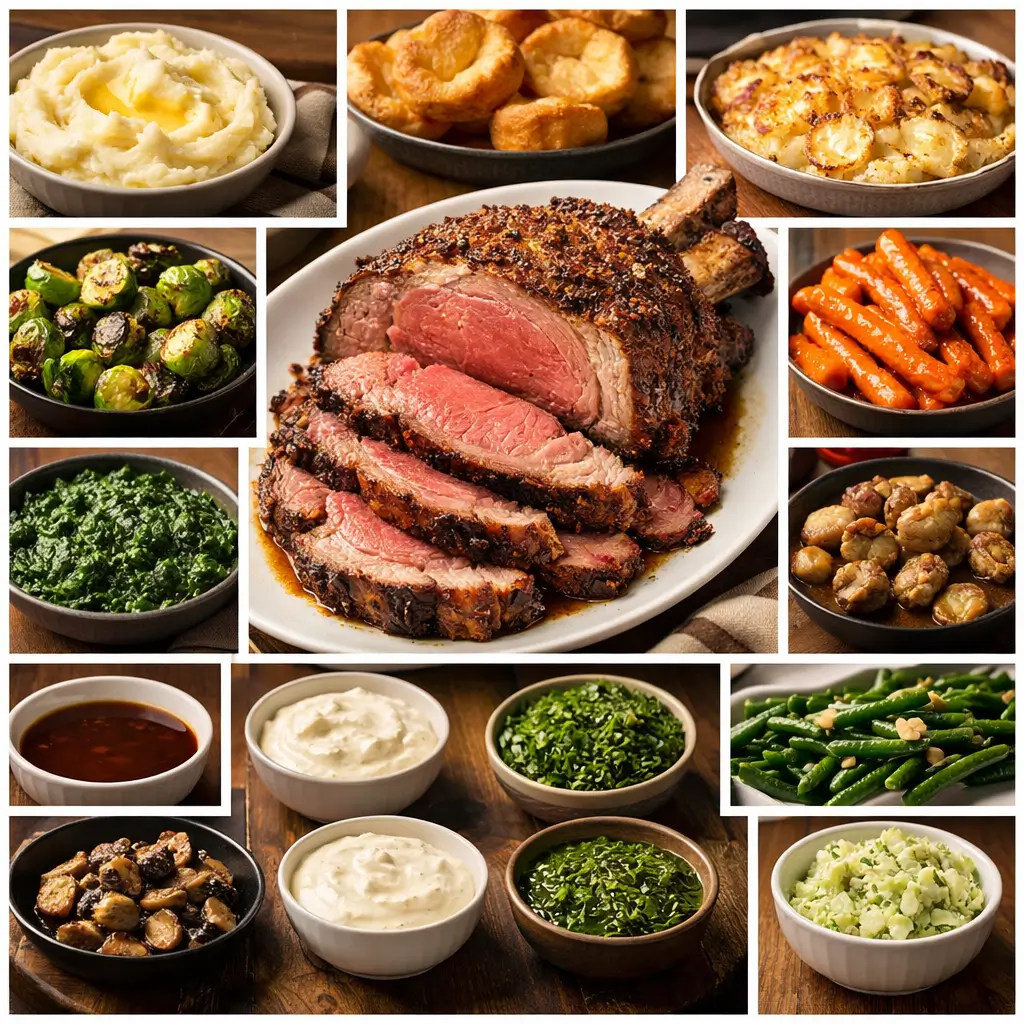
Best Side Dishes
Starchy, creamy sides pair best with the richness of ribeye roast. Yorkshire pudding is the traditional accompaniment the batter baked in the hot beef drippings from the roasting pan, puffed and golden. Whipped or mashed potatoes, twice-baked potatoes, and roasted fingerling potatoes are all excellent. Scalloped potatoes add a decadent, layered option for larger holiday meals.
For vegetables, creamed spinach, roasted Brussels sprouts, garlic-butter mushrooms, roasted green beans, and glazed carrots all complement the richness of the beef without competing with it. If you want another easy potato side, these garlic Parmesan potato wedges are also a great match for ribeye roast.
Best Sauces
Au jus is the classic and correct pairing the pan drippings deglazed with a little beef broth and reduced into a thin, intensely beefy sauce that is poured over or served alongside each slice. Creamy horseradish sauce provides the acidic contrast the richness of the beef calls for, and it is easy to make. Red wine pan sauce, chimichurri, and compound herb butter are all excellent alternatives.
Holiday Dinner Pairing Ideas
Christmas: Creamed spinach, Yorkshire pudding, roasted root vegetables, red wine au jus, and horseradish cream. Finish with a classic red Burgundy or Cabernet Sauvignon.
Easter: Roasted asparagus, scalloped potatoes, spring herb salad, and a simple pan au jus brightened with a splash of Dijon mustard.
New Year’s Eve: Truffle mashed potatoes, haricots verts with almonds, Béarnaise sauce, and a rich Bordeaux or Côtes du Rhône.
How to Store and Reheat Leftovers
Refrigerator Storage
Wrap leftover roast tightly in plastic wrap or store in an airtight container. It will keep for up to 4 days in the refrigerator. Store with any leftover au jus the liquid will help keep the meat moist and is the key to successful reheating.
Freezing Tips
Slice the roast before freezing rather than storing it whole. Individual slices wrapped tightly in plastic wrap and then placed in a zip-lock freezer bag will keep for up to 3 months without significant quality loss. Thaw overnight in the refrigerator before reheating never thaw at room temperature.
Best Way to Reheat Without Drying Out
The best reheating method is the stovetop: slice the beef thinly, add it to a shallow pan with a generous splash of beef broth or leftover au jus, and warm over low heat just until heated through. The liquid prevents direct contact with the hot pan surface and keeps the meat from tightening and drying.
For the oven: wrap slices loosely in foil with a tablespoon of broth, and heat at 250°F for 15 to 20 minutes. Avoid the microwave the rapid, uneven heat drives out moisture quickly and toughens the muscle fibers. Leftover ribeye roast also makes outstanding beef sandwiches, breakfast hash with eggs and potatoes, or tacos with salsa and crema.
Troubleshooting Bone-In Ribeye Roast
Why Is It Overcooked on the Outside?
The most common cause is leaving the roast at 450°F for too long before reducing to 325°F, or forgetting to reduce the temperature at all. The 15-minute sear window is a maximum, not a target reduce the oven temperature as soon as the exterior is deeply browned. Overcooking on the outside also happens when the roast goes into the oven straight from the refrigerator, because the cold center forces you to cook longer overall, overdoing the exterior in the process.
Why Is the Center Undercooked?
The roast was too cold when it went into the oven, or the probe thermometer was not placed at the true center. If you find yourself with an undercooked roast, do not blast it back in at high heat. Return it to a 275°F oven in 10-minute increments, checking temperature after each interval. Low and slow saves a roast that high heat will ruin.
Why Didn’t It Get a Crust?
Three common reasons: the surface was wet when the roast went into the oven (always pat completely dry); the oven was not fully preheated before the roast went in; or the roast was covered during the sear phase. Dry-brining 24 to 48 hours ahead makes a dramatic difference to crust development — the salt dries the surface and concentrates the proteins, giving you a deeper, cracklier crust than any amount of hot-oven searing alone can achieve.
Why Is It Hard to Carve?
Most carving problems come down to two things: insufficient resting time, and the wrong knife. If the roast has not rested for at least 20 minutes, the internal juices are still mobile and the muscle structure is too hot and relaxed to hold together cleanly under the blade. A 12 to 14 inch slicing knife is the right tool — anything shorter forces you to saw, which tears rather than cuts.
Frequently Asked Questions
How do you cook a bone-in ribeye roast?
Season generously and bring to near room temperature. Sear in a 450°F oven for 15 to 20 minutes to build the crust, then reduce to 325°F and roast until a probe thermometer reads 8 to 10 degrees below your target temperature. Rest tented with foil for 20 to 30 minutes before carving.
Is a bone-in ribeye roast the same as prime rib?
Yes, essentially. Both names refer to the same cut: the rib primal (ribs 6 through 12), cooked as a whole roast. “Prime rib” is almost always bone-in; “ribeye roast” more often refers to the boneless version. The word “prime” refers to the cut, not the USDA grade.
How long do you cook a bone-in ribeye roast per pound?
After a 15-minute sear at 450°F, cook at 325°F for approximately 18 to 20 minutes per pound for medium-rare. Always verify doneness with a thermometer — pull at 120 to 125°F and rest to 130 to 135°F.
What is the 500 rule for prime rib roast?
Multiply the roast’s weight in pounds by 5 to get the number of minutes to cook at 500°F. Turn the oven off after that time and leave the door closed for exactly 2 hours. The residual heat finishes the roast. This method works best for boneless roasts in well-insulated ovens, but carries risk if your oven loses heat quickly.
Should a bone-in ribeye roast be cooked covered or uncovered?
Always uncovered. You need dry radiant heat to build the crust. Cover the roast with foil only during the resting stage after it comes out of the oven.
What temperature should a bone-in ribeye roast be?
For medium-rare — the most recommended doneness for this cut — pull from the oven at 120 to 125°F and rest to a final temperature of 130 to 135°F. See the full doneness chart above for rare through medium-well.
Do you rest a bone-in ribeye roast before slicing?
Yes, always. Rest for a minimum of 20 minutes, tented loosely with foil. Resting allows the internal temperature to finish rising and allows the muscle fibers to relax and reabsorb the juices pushed out during cooking. Slicing too early causes all those juices to run out onto the cutting board, leaving the meat dry.
Conclusion
A bone-in ribeye roast is one of those rare dishes that rewards both the cook and everyone at the table in equal measure. The method is simpler than it looks: season it well, sear it hot, roast it slow, pull it at the right temperature, and let it rest. The bone does much of the heavy lifting — insulating the meat, enriching the flavor, and making the whole roast look extraordinary before a single slice is carved.
The most important tool you can own for this cook is a leave-in probe thermometer. It takes the uncertainty out of an expensive piece of beef and gives you full control from the moment the roast goes into the oven to the moment it comes out. With that one tool and the time chart above, there is nothing left to guess.
Whether you are making this for Christmas, Easter, a New Year’s table, or simply a Sunday that calls for something extraordinary, this is the recipe you will come back to. The bones will be gnawed and fought over. The slices will disappear faster than you expect. And someone at the table will inevitably ask you how you did it.
Bone-In Ribeye Roast Recipe

Equipment
- Heavy-duty roasting pan
- Roasting rack
- Leave-in probe thermometer
- Carving knife
- Butcher’s twine
- Aluminum foil
Ingredients
Roast
- 1 bone-in standing rib roast 4 to 6 pounds, about 3 to 4 bones
Seasoning
- 2 tbsp kosher salt or 1 to 1.5 teaspoons per pound
- 1 tbsp coarse black pepper freshly cracked
- 5 cloves garlic minced or mashed into a paste
- 2 tbsp olive oil or beef tallow to help the seasoning stick
- 4 tbsp unsalted butter softened, optional
- 2 sprigs fresh rosemary finely chopped, optional
- 3 sprigs fresh thyme finely chopped, optional
Instructions
- Remove the bone-in ribeye roast from the refrigerator 1 1/2 to 2 hours before cooking so it loses some of its chill. Pat it completely dry with paper towels.
- Preheat the oven to 450°F. Set a rack inside a heavy roasting pan.
- Mix the kosher salt, black pepper, garlic, olive oil or beef tallow, and softened butter if using. Rub the mixture all over the roast, including the sides and exposed bone ends. Add the chopped rosemary and thyme if using.
- Place the roast fat-side up on the rack or stand it rib-side down if the bones create a stable base. Insert a leave-in probe thermometer into the center of the eye muscle, making sure the tip does not touch bone.
- Roast uncovered at 450°F for 15 to 20 minutes to develop a deep brown crust.
- Reduce the oven temperature to 325°F and continue roasting until the thermometer reads 120 to 125°F for medium-rare, or 8 to 10 degrees below your desired final temperature.
- Transfer the roast to a cutting board and tent loosely with foil. Rest for 20 to 30 minutes so carryover cooking can finish the roast and the juices can redistribute.
- Cut away the bones if needed, then slice the roast against the grain into 1/2-inch to 3/4-inch slices. Serve immediately.